project-image

Swords at Dusk

Created by OrigamiAndroid

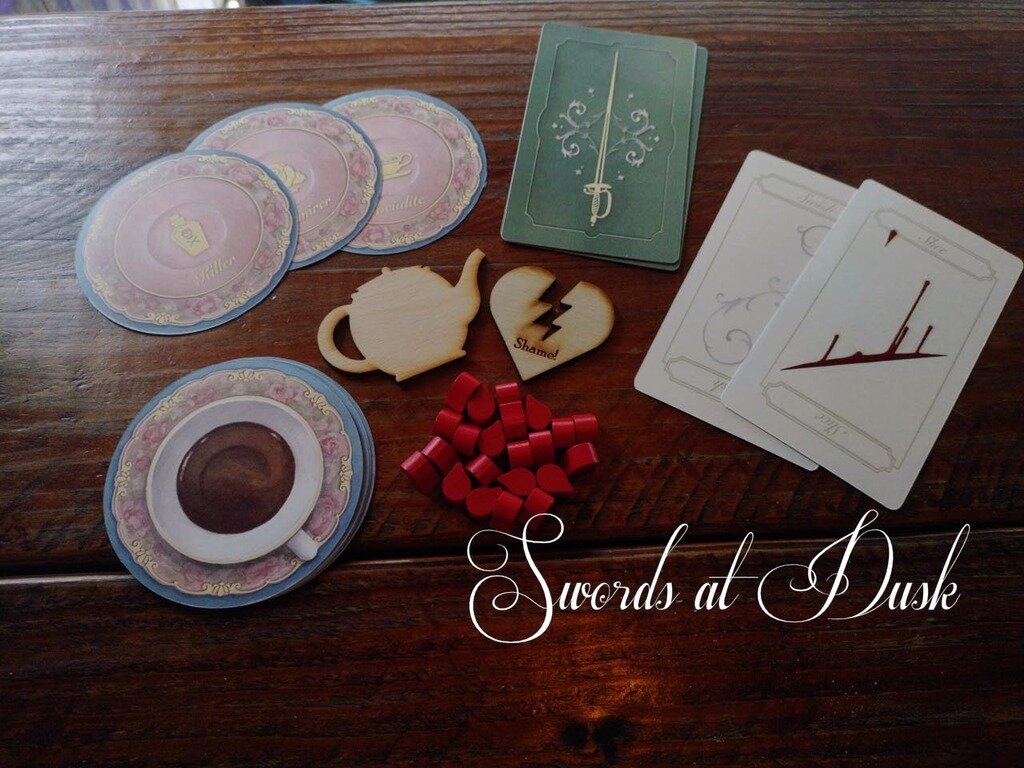
Swords at Dusk is a 4-8 player social deduction game in which you play as a socialite in a manor being terrorized by a hidden killer. In the manor there's only one way to bring them to justice, the honorable act of dueling!

Latest Updates from Our Project:

(10/5/2024) Plan B
over 1 year ago – Sat, Oct 05, 2024 at 06:25:12 PM

It looks like we’re not gonna make our (admittedly lofty) goal by the end of the campaign, but I’m not discouraged. If there’s anything I’ve learned from the past month, it’s that people are really interested in the game, it’s just a matter of taking more time to get the word out to more people. I’ve also learned of manufacturers that are willing to do 500 copy minimum orders.

I wasn’t expecting my first crack at crowdfunding to be a successful one.The reason I wanted to start the campaign was because I wanted to tell people that I’m working on this and it looks like there are a number of people interested enough. I might have not gotten the funding I needed this month, but I plan on doing another campaign March of next year, as part of Backerkit’s Pocketopia collaboration event.


Behind the scenes: Dueling
over 1 year ago – Thu, Oct 03, 2024 at 03:46:31 PM

Dueling was probably the thing that changed the most throughout the process of developing this game. Did you know that the original prototype literally had players wail on each other with foam swords? 


Obviously, the game back then was more of a physical activity with a board game attached to it, but I wanted to turn the game into a complete board game for wider distribution. 

The thing I aimed for was something that was easy to do quickly, so I went for a themed sort of “rock paper scissors” system in which players would pick cards, and reveal them, but early playtesting showed that if you gave players a card game of rock, paper scissors, they will take all day figuring out their move.


The version of dueling that is now didn’t come until much later– and it turns out changing the way duels worked was what was needed to break the game wide open.

I was very much inspired by Secret Hitler’s Policy tile mechanic. For those of you who haven’t played it, Secret Hitler’s core of the game comes from the interaction between two players: the President, a role that rotates around the table, and the Chancellor, a player who is nominated, then elected into the role. 

That mechanic inspired the changes with privilege-- What if the privileged player had some sort of "Control" of the duel, with a little dash of random chance to keep things interesting? I ended up playtesting both changes to the dueling and privilege mechanics at the same time, and those two changes gave the game a new life.


Through playtesting, I figured out that involving just one more person in duels added a whole new way for people to test each other’s loyalty, all while making dueling much more interesting.  That way, everyone gets a little more involved during downtime, because duels could actually give you an insight on more people, and it's another way to clue people in on someone's allegiances, and made the game a lot more fun to watch for non-dueling participants.

Along with this behind the scenes entry, I also want to announce I'll be doing another live Demo over in Brooklyn's Twenty Sided Store this Saturday, if you have time, come by and say hi! Here's a link to the event.


Behind the Scenes: Developing privilege
over 1 year ago – Wed, Oct 02, 2024 at 03:36:43 PM

Privilege was the last mechanic that I added into the game, and for a while, it did all sorts of things. The main goal of Privilege was to introduce a “Role” without it being an actual “Role”, as well as add something that could be something more to talk about.

The idea of some passable token came about during a playtest right before PlayNYC, and it started off as something a little wilder: The original privilege still had it’s wound-healing power, but it also had the power to force two players to duel each other, which was a hit– mainly because it got people dueling sooner.


The reason I ended up tweaking privilege into its present state was partly because I couldn’t figure out a good term for the forced duel, and thematically, it would make more sense if there was a way for the privileged person to affect duels, not start them. 

The mechanic evolved further into it's final version as I tweaked the dueling mechanics from a familiar “Rock Paper Scissors” to an even simpler, more flexible dueling system, which made people much less hesitant to challenge each other, because It turns out dueling just had to be really simple– a discovery I’ll post about tomorrow.


Behind the scenes: How I stopped worrying and learned to love the first round
over 1 year ago – Fri, Sep 20, 2024 at 12:17:37 PM

Classic social deduction games like Werewolf/Mafia have one key issue that keeps everyone from playing– lack of information. Many modern social deduction games have introduced systems and mechanics that allow hints of who might be on who’s side through loyalty testing. Every time I start playtesting Swords at Dusk, I've gotten used to the first round where everyone opens their eyes and everyone has no idea what to do.


In order to avoid that awkward first round early on, I decided to have a “Seer” role to try and give the game some form of information; it like the obvious fix. However, giving perfect information to one person and hoping that information gets disseminated throughout the rest of the group is kind of a trap– not everyone is a good seer. I would venture to say that most of us suck at being Seer, and let’s be real, if there’s only one “Bad” guy in the group, what does the seer do with their power after they find the killer? 

At some point, I decided that this was not a bad thing, because as soon as the wounds start stacking up, everyone starts talking, so I decided to embrace the awkward silence as a part of the genre, and at the end of the day, nobody remembers the first round of Mafia, they remember the twists and turns that come after hurting a few people.

But I do wonder, when faced with an awkward first round of any social deduction game, what's your first move? I'd love to hear from you in the comments.


20 Backers! Woo!
over 1 year ago – Wed, Sep 18, 2024 at 11:53:16 AM

Thank you so much to all 20 of you, who saw this game and decided to give it a chance. It might not seem like a lot of folks in comparison to my extremely optimistic goal, but whenever I wake up and check on the campaign, seeing a new name that I don't recognize is the best feeling. It means that you all took enough of a liking to my project to invest in it, and that's what's been keeping me going the past week or so as I obsessively the project page while on break between teaching classes.

So thank you. Here's to celebrating more milestones before the campaign ends!

More post-mortem-y stuff coming before the end of the week this week.